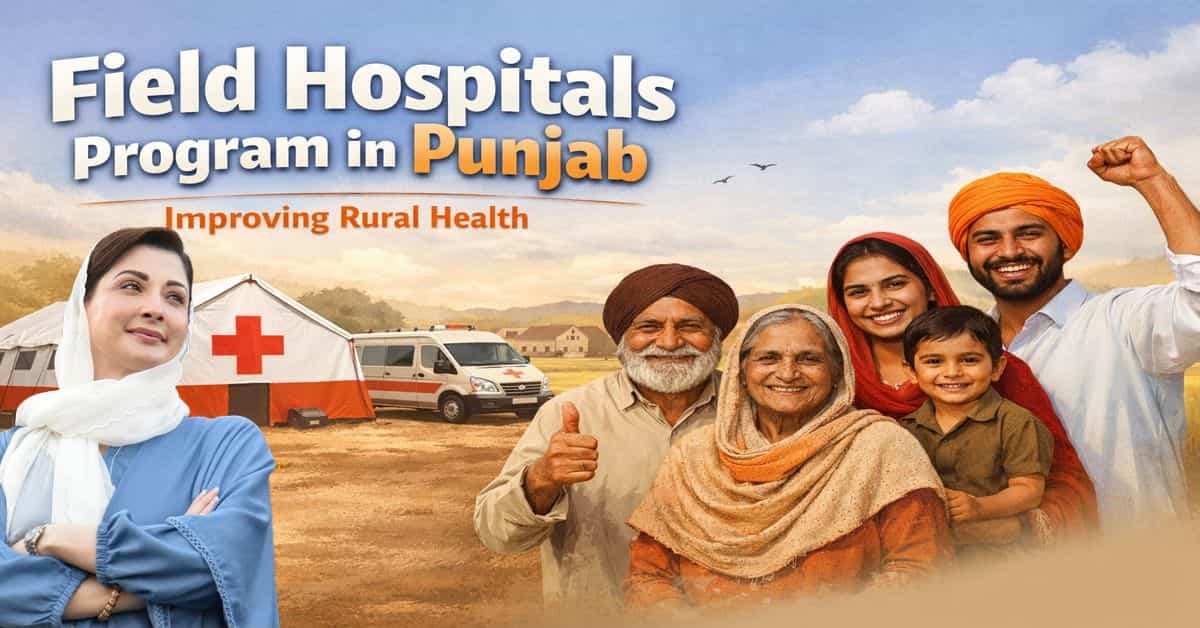
In Punjab’s rural and underserved regions, access to quality healthcare continues to be a challenge. In order to resolve this issue, the Punjab government implemented the Field Hospitals Program, which is a component of the Clinic on Wheels initiative. Its primary objective is to guarantee that residents of low-resource communities, urban neighborhoods, and remote areas receive essential care without the need to travel long distances, by providing free and accessible medical services..
This program has established itself as a model for the expansion of healthcare coverage throughout the province in 2026, thereby illustrating the efficacy of mobile healthcare delivery.
Purpose and Significance of the Program in 2026:
Rural Pakistan remains plagued by healthcare inequality, as numerous residents encounter financial constraints, inadequate conveyance, and restricted access to hospitals. Field Hospitals Program addresses these concerns by:
- Directly delivering medical facilities to communities
- Mitigating patient congestion in tertiary hospitals
- Providing complimentary diagnostics and essential medications
- Guaranteeing gender-inclusive care by employing both male and female physicians
This method has enhanced trust in public health services, reduced healthcare costs, and improved early disease detection.
Deployment and Operational Reach:
As of 2026, 34 field hospitals are operational across Punjab:
- Mobile Healthcare Units: 21 units providing OPD, diagnostics, and pharmacy services
- Small Field Hospitals (Diagnostic Units): 11 units offering ultrasound and laboratory testing
The strategic placement of these units in rural and marginalized areas guarantees a greater degree of healthcare accessibility and the ability to relocate in response to demand.
Services and Facilities Provided:
Each field hospital is outfitted to provide essential healthcare services in a mobile setting. Services encompass:
Diagnostic Services:
- Laboratories that are fully operational
- ECG and ultrasound capabilities
- X-ray devices that operate digitally
Outpatient Care:
- Consultations with a general practitioner
- Specialized care that is fundamental
- Screening for chronic diseases
Pharmacy Services:
- The distribution of approximately 40 essential medications is free of charge.
- The Directorate General Health Services guarantees consistent quality through the centralized supply.
Maternal, Child, and Emergency Care:
- Prenatal and postnatal examinations
- Nutritional guidance and surveillance of child health
- Immediate stabilization and first aid, with referrals to adjacent hospitals as necessary
Collectively, these services enhance the survival rates and healthcare outcomes of marginalized regions.
Operational Strategy and Efficiency:
The program’s success is a direct result of meticulous planning:
- Field hospitals are located in high-need areas and are coordinated with local authorities to ensure that the optimum number of patients are seen on a daily basis.
- Efficient utilization of resources is guaranteed by minimal service overlap.
- Mobile units can be relocated in accordance with the population’s requirements, enabling a flexible response to healthcare demands.
Pay-for-Performance Model:
One of the program’s most innovative features is the Pay-for-Performance Model, which compensates healthcare providers according to:
- Total number of patients treated
- Diagnostic precision and quality
- In general, patients’ outcomes
This ensures accountability and promotes high-quality care, transcending the limitations of volume-based healthcare delivery.
Impact and Patient Reach:
The program has reached over 1.2 million patient visits to date, including:
- OPD visits: 1,096,272
- Laboratory tests: 305,119
- X-rays conducted: 5,655
This illustrates the program’s tangible influence on public health, as evidenced by the consistent utilization of services and the strong community trust.
Types of Field Hospitals:
Large Field Hospitals (LFH):
- Staff: 2 medical officers (male and female)
- Facilities: X-ray, ultrasound, laboratory with 11+ test types
- Designed for high-density population areas
Small Field Hospitals (SFH):
- Staff: 1 medical officer
- Facilities: Ultrasound and laboratory with 11+ test types
- Focused on remote or low-population regions
Benefits of Field Hospitals Program in Punjab:
- Increased Healthcare Accessibility
Field hospitals bring medical services directly to rural and underserved communities, eliminating the need for patients to travel long distances for care. - Free Diagnostics and Medications
Patients receive essential laboratory tests, imaging, and around 40 essential medicines at no cost, reducing financial burdens on families. - Reduced Hospital Congestion
By handling routine and minor cases, the program decreases patient loads in larger hospitals, allowing tertiary centers to focus on critical care. - Maternal and Child Health Support
Dedicated services for women and children, including prenatal and postnatal care, child growth monitoring, and nutrition guidance, improve health outcomes. - Early Disease Detection
Regular screenings for chronic and common diseases help detect conditions early, enabling timely treatment and preventing complications. - Gender-Inclusive Care
Both male and female doctors are available, ensuring culturally sensitive care and encouraging women to access medical services. - Emergency and First Aid Services
Immediate stabilization and basic emergency care are provided, with referrals to nearby hospitals when required, improving survival rates. - Flexible and Mobile Operations
Units can be relocated based on population needs, allowing the program to respond dynamically to areas with higher healthcare demands. - Performance-Based Quality Care
The Pay-for-Performance model incentivizes healthcare providers to deliver accurate diagnostics and effective treatment, promoting accountability. - Strengthened Community Trust
Consistent, reliable services build confidence in public healthcare, encouraging more residents to seek medical attention when needed.
Conclusion:
The Field Hospitals Program in Punjab has transformed healthcare delivery in 2026. By combining mobile units, diagnostics, free medicines, and a performance-based care model, it effectively reaches underserved populations, improves early diagnosis, and strengthens public health outcomes across the province.
Frequently Asked Questions:
Are the medicines provided at field hospitals free?
Yes, around 40 essential medicines are provided free of cost, supplied through a centralized system to ensure consistent quality and availability for all patients.
Who manages and operates the Field Hospitals Program?
The program is managed by the Chief Minister of Punjab’s office, with medical supplies and operational support provided by the Directorate General Health Services.
How does the Pay-for-Performance model work?
Healthcare providers are rewarded based on the number of patients treated, quality and accuracy of diagnostics, and patient outcomes, which ensures high-quality care and accountability.