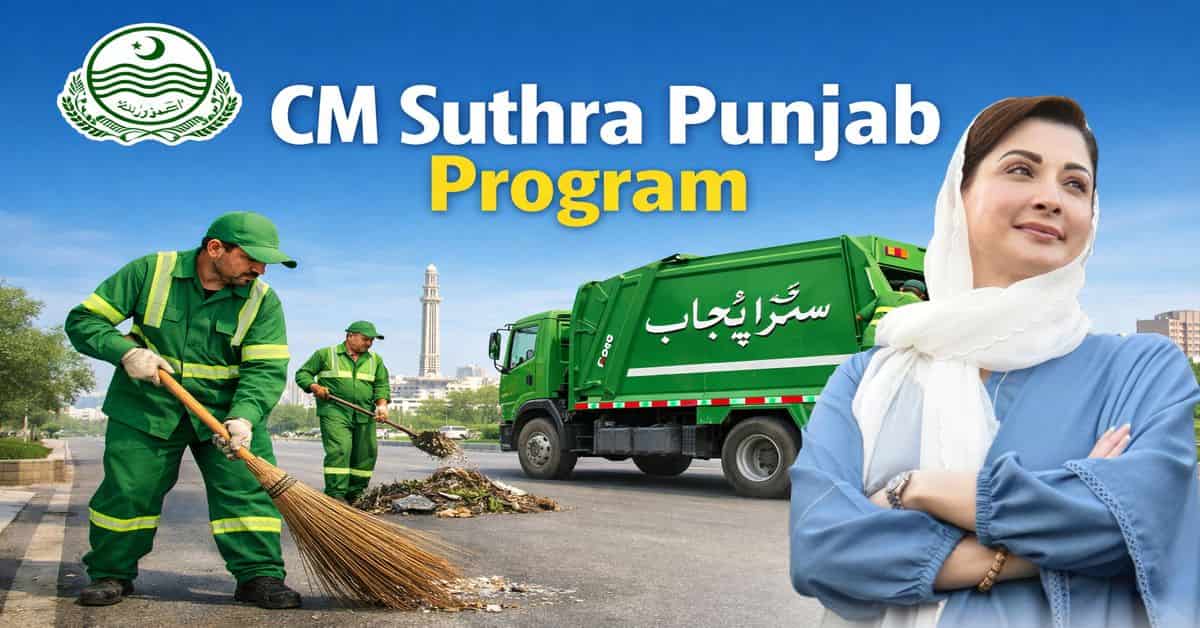
Punjab’s most ambitious hygiene and sanitation initiative to date is the CM Suthra Punjab Program 2026. The program, which is overseen by Chief Minister Maryam Nawaz Sharif, is designed to eradicate visible waste in cities and villages, while simultaneously fostering environmental sustainability and public health.
It accomplishes its objectives by integrating public participation, technology-driven monitoring, and structured planning.
Purpose and Vision:
The program’s fundamental objective is straightforward yet significant:
- Eliminate visible refuse in both urban and rural areas.
- Enhance residents’ living conditions.
- Restore public spaces for the community’s use.
The vision is consistent with contemporary urban development objectives, emphasizing sustainable waste management systems, healthy communities, and clean streets. The initiative endeavors to comprehensively address the health risks, unmanaged pollution, and increasing population pressure that Punjab is currently experiencing.
Key Objectives:
- Zero Waste Target: Emphasize cleanliness as a shared civic responsibility by achieving the elimination of visible refuse throughout the province within 90 days.
- Integrated Waste Management: A standardized sanitation model is implemented in all districts to guarantee consistent service and hygiene standards.
- Public-Private Collaboration: Partnerships between private waste management firms and government departments improve accountability, efficiency, and long-term sustainability.
Core Features of the Program:
- Smart Workforce Monitoring: In order to mitigate absenteeism and guarantee task completion, sanitation staff attendance is monitored through geo-tagged, time-stamped, and photo-based systems.
- Door-to-Door Collection: The regular collection of household refuse prevents open dumping and enhances community hygiene.
- Manual Sweeping and Drain Maintenance: The daily cleaning of streets and the desilting of drains prevent the proliferation of mosquitoes and waterlogging.
- Open Heap Clearance: The removal of large waste dumps is achieved through the use of heavy machinery, which enhances urban aesthetics and air quality.
- Real-Time Technology Monitoring: Central dashboards enable authorities to monitor daily performance, confirm task completion, and implement immediate corrective measures when required.
Environmental and Health Benefits:
- Cleaner Air: Reduced waste burning enhances air quality and mitigates the risk of respiratory illnesses.
- Healthier Communities: The dissemination of diseases, such as dengue, cholera, and skin infections, is reduced by the proper disposal of refuse.
- Restored Public Spaces: Markets, streets, and parks are revitalized to create communal spaces that are functional.
Economic and Social Impact:
- Employment Generation:Local livelihoods are sustained by the creation of thousands of sanitation employment.
- Tourism Boost: The presentation of heritage sites is enhanced, and tourists are attracted to cleaner urban areas.
- Enhanced Quality of Life: Property values and health are positively influenced by cleaner, safer environments.
Coverage Across Punjab:
In contrast to previous initiatives, Suthra Punjab 2026 guarantees equitable access to sanitation services by incorporating both urban and rural areas. District administrations adhere to a consistent operational framework, ensuring that no area is overlooked.
Public Participation:
Citizens are encouraged to participate actively in the initiative:
- Complaint Registration: The Suthra Punjab Shehri App or the helpline 1139 are the two methods by which citizens can report issues. Complaints are monitored digitally until they are resolved.
- App Usage: The app allows residents to download, register, submit complaints with photos, and monitor the status in real-time, thereby ensuring a faster response and greater transparency.
Comparison with Previous Campaigns:
| Aspect | Previous Campaigns | Suthra Punjab 2026 |
|---|---|---|
| Coverage | Limited cities | Entire province |
| Monitoring | Manual | Digital, real-time |
| Accountability | Low | High |
| Public Reporting | Minimal | App and helpline support |
This illustrates the program’s structured, results-oriented methodology in contrast to previous endeavors.
Challenges:
- Public Awareness: There are still individuals who engage in the practice of unlawful waste disposal, necessitating ongoing education.
- Sustainability Beyond 90 Days: It is imperative to preserve sanitation beyond the initial target period.
- Rapid urbanization necessitates ongoing system enhancements due to the growing population and waste volumes.
Long-Term Sustainability Strategy:
In order to guarantee an enduring effect, the authorities intend to:
- Enforce waste disposal laws strictly.
- Expand recycling initiatives and waste segregation programs.
- Promote civic education on sanitation in schools and communities.
The objective of these measures is to sustain a cleaner Punjab beyond the initial 90-day campaign.
Conclusion:
The Suthra Punjab Program 2026 represents a major evolution in sanitation management. By combining technology, strict monitoring, public participation, and strategic planning, it aims to achieve a zero-waste Punjab, creating cleaner, healthier, and more sustainable communities for all residents.
Frequently Asked Questions:
Does the program cover rural areas as well?
Yes, unlike previous campaigns, Suthra Punjab 2026 provides services across all districts, including villages, ensuring equitable sanitation coverage throughout the province.
What are the main goals of the program?
The program’s primary goals are to eliminate visible waste, improve hygiene and public health, restore streets and parks, and create a sustainable waste management system for Punjab.
How is the program monitored for effectiveness?
Authorities use technology-driven monitoring, including geo-tagged photos, time-stamped records, and central dashboards, to track sanitation staff performance and progress in real-time.