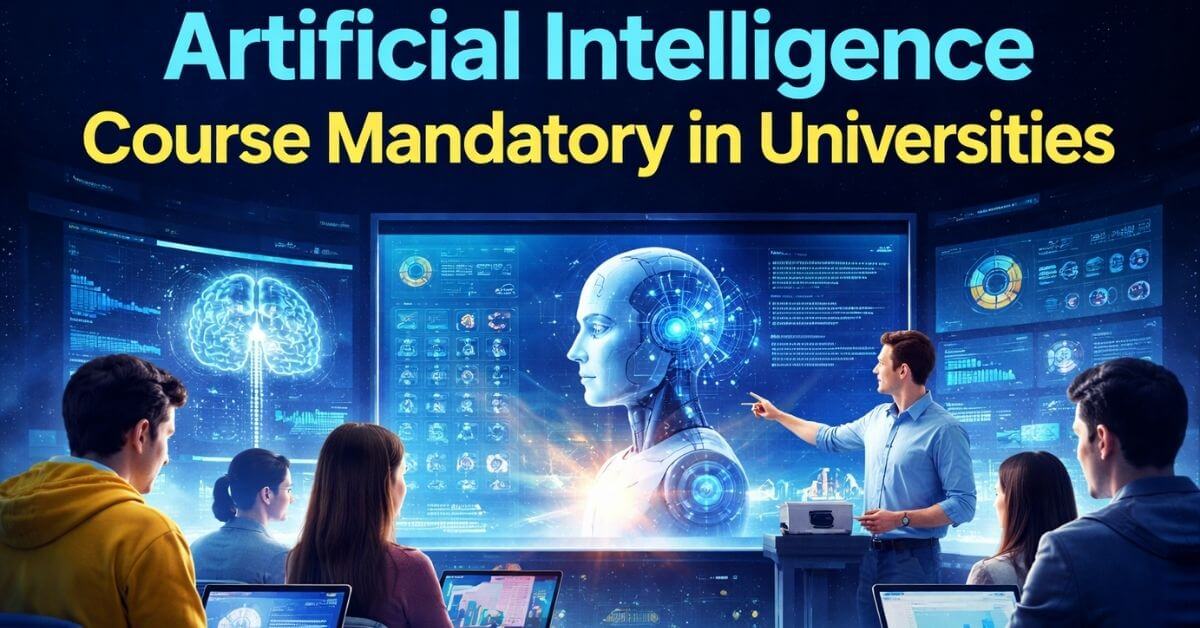
Artificial Intelligence Course Mandatory in Universities in 2026: The Higher Education Commission (HEC) of Pakistan wants to make Artificial Intelligence (AI) a required topic in universities. This will be a big change for higher education in Pakistan. The policy’s goal is to teach current technology as part of degree programs so that students are better prepared for the digital economy, which is changing quickly.
The plan says that starting with the 2026 school year, all universities in Pakistan will have to offer an AI course as part of their regular curriculum. Experts in education think that this step will help students learn how to use new technologies and make them more competitive in job markets around the world.
Policy Overview:
| Policy Detail | Information |
|---|---|
| Policy Title | Artificial Intelligence Mandatory Course |
| Announced By | Higher Education Commission (HEC) |
| Implementation Year | 2026 Academic Session |
| Institutions Covered | All Public and Private Universities |
| Course Credit Hours | Three Credit Hours |
| Programs Included | Undergraduate and Postgraduate Degrees |
| Key Objective | Promote AI literacy and digital skills |
| Official Website | https://www.hec.gov.pk |
Why AI Is Being Introduced as a Mandatory Course?
AI is changing many fields around the world, such as healthcare, banking, education, manufacturing, and government services. In response to this change, HEC wants to make sure that Pakistani college graduates know the basics of AI and can use it safely in their own areas.
Universities will have to offer a three-credit-hour AI course to all students, no matter what academic field they are in, as part of the suggested policy.
Key goals of the initiative include:
- Getting students to understand current technologies better
- Getting university courses to match up with standards for foreign education
- Getting grads ready for global job markets that are driven by technology
- promoting the safe and ethical use of artificial intelligence
Nationwide Implementation in Universities:
The policy will apply to all HEC-recognized universities in Pakistan, including both public and private institutions. Universities will be required to update their academic programs before the Fall 2026 intake.
Major implementation requirements include:
- The AI course must be part of all undergraduate and graduate studies.
- Universities must go through academic boards to review and approve new courses.
- Institutions must make sure they have skilled teachers and teaching materials.
- Students who sign up after the 2026 session will have to take AI as a topic.
Key Topics Covered in the AI Course:
People who take the new course should learn both the theory and practice of artificial intelligence. Students from a range of fields will learn how AI tools affect their own fields.
Core topics may include:
- A look at artificial intelligence and machine learning
- Different businesses use AI in different ways
- Data ethics, privacy, and using technology in a smart way
- AI systems should be fair, open, and answerable.
Implementation Process for Universities:
To introduce the AI course successfully, universities will follow a structured implementation plan.
Typical steps include:
- Official policy directions are sent to universities by HEC.
- Academic councils look over and agree to changes to the program.
- Course outlines and teaching tools are made by departments.
- Faculty members get training on how to teach the basics of AI
- The course is now part of both college and graduate-level degree programs.
- From the 2026 school year on, students have to take the required class.
Check Also: Pakistan Universities Nominated for International Awards
Benefits for University Students:
- Better digital literacy: Students will learn a lot about new technologies and AI tools, which will help them adapt to the digital world that is changing quickly and use advanced technology with confidence in school and the workplace.
- Better Job Opportunities: Learning the basics of AI will make graduates more competitive in the global job market. This will lead to high-demand jobs in technology, data science, robotics, and other new digital fields.
- Knowledge Useful in Your Field: The AI class will teach students how artificial intelligence is used in real life in fields like business, education, healthcare, and banking. This will help them understand how technology is changing the way people work today.
- Stronger Problem-Solving and Analytical Skills: Learning about AI and data-driven systems will help students think more critically, which will let them look at difficult problems and come up with new ways to solve them.
- Global Academic Competitiveness: Adding AI to university courses will bring Pakistan’s higher education system in line with international academic standards. This will make sure that graduates can compete with students from the best universities around the world.
- Understanding Ethical and Responsible AI Use: Students will learn about data protection, algorithmic fairness, and responsible technology practices. This will help them use AI in ways that are moral, clear, and good for society.
Contact Information for Further Details:
Students and universities seeking official updates can contact the Higher Education Commission through the following channels:
- Official Website: https://www.hec.gov.pk
- Helpline: +92-51-90400000
- Email: info@hec
- Head Office: H-9, Islamabad, Pakistan
Students are advised to confirm updates directly from official sources or their university administration.
Conclusion:
There should be a required course in artificial intelligence. This is a big step toward improving Pakistan’s higher education system. It’s becoming more and more important to give students the basic information and technical skills they need as AI continues to change industries around the world.
Pakistan wants to prepare its pupils for a future driven by technology and make them more competitive in the global job market by adding AI education to university programs starting in 2026.
Will the artificial intelligence course apply to all students?
Yes, the artificial intelligence course is expected to be compulsory for students across multiple academic disciplines. Universities will include it in undergraduate and postgraduate programs so learners from science business engineering and other fields can understand AI applications and technology impact.
How does an artificial intelligence course benefit university students’ future careers?
Artificial intelligence education can significantly improve students’ career prospects by building valuable technical knowledge. Graduates with AI understanding can access opportunities in technology research business analytics and automation sectors, where companies increasingly require professionals with digital innovation and problem-solving abilities.
When will universities start artificial intelligence course implementation nationwide?
Universities are expected to start implementing the artificial intelligence course from the 2026 academic session. Institutions will update their curricula train faculty members and prepare learning resources so students enrolling in upcoming sessions can begin studying artificial intelligence fundamentals.